

AI Is Rewriting the Rules of Banking: Here’s How Black Entrepreneurs Can Hack the System Back
By Sean Findlay
Published on BlackWallStreet.ca
“The game is changing. Just putting whatever on a credit application isn’t going to work anymore. The banks are using AI to track transactions and decide your worth in real time. It’s time we start using AI right back.”
In the latest high-octane episode of Melanin Money, financial strategist Herman Dolce Jr. and the team delivered a wake-up call to entrepreneurs and aspiring wealth-builders: institutional algorithms are already being leveraged against everyday borrowers. But with the right prompts, software tools, and structural leverage, you can turn artificial intelligence into a personal CFO, credit attorney, and funding strategist—all in one.
Step 1: Turn ChatGPT into a High-Yield Funding Consultant
When small businesses apply for lines of credit, banks use predictive models to flag risk factors like subtle credit swings, recent hard inquiries, or unbalanced debt-to-income ratios.
Dolce outlines a simple, repeatable process to put an AI strategist in your corner:
1. Pull Your Full Credit File
Always use raw, unedited PDF reports
Head over to IdentityIQ (United States) (or an equivalent reporting service) and export your full credit profile directly as a clean PDF file to your computer.
2. Upgrade Your AI Capabilities
Free versions struggle with complex file analysis
Subscribe to the paid tier of ChatGPT Plus ($20/month). Uploading large financial PDFs requires advanced multimodal data processing.
3. Deploy the ‘Lending Bureau’ Prompt
Force the model into a strict underwriting role
Prompt ChatGPT: “Act like a senior bank underwriting officer. I want to raise $100,000 in business funding. Analyze my uploaded credit profile and give me a step-by-step blueprint: Which specific banks should I apply to? Which balances must I pay down first? How many inquiries do I need to clear on TransUnion?”
4. Execute the Custom Playbook
Avoid wasted hard pulls
Follow the tailored instructions. If the AI notes that an Amex balance is slightly too high for an upcoming credit pull, lower it to the recommended threshold before applying.
Step 2: Draft Fair Credit Reporting Act (FCRA) Dispute Letters
If your credit profile holds negative marks, AI can assist with dispute proceedings. Under the Fair Credit Reporting Act (FCRA), bureaus must verify every piece of negative data upon request.
By feeding your credit PDF into ChatGPT with instructions to act as a top-tier consumer rights law firm, you can quickly generate structured, multi-round dispute letters targeting invalid inquiries, charge-offs, or reporting errors.
PROMPT EXAMPLE:
“Act as an expert FCRA consumer law attorney. Review my attached credit report for incorrect reporting standards. Draft Round 1 dispute letters targeting negative items, citing FCRA compliance requirements for investigation.”
Step 3: Shift from Credit Cards to Asset Arbitrage
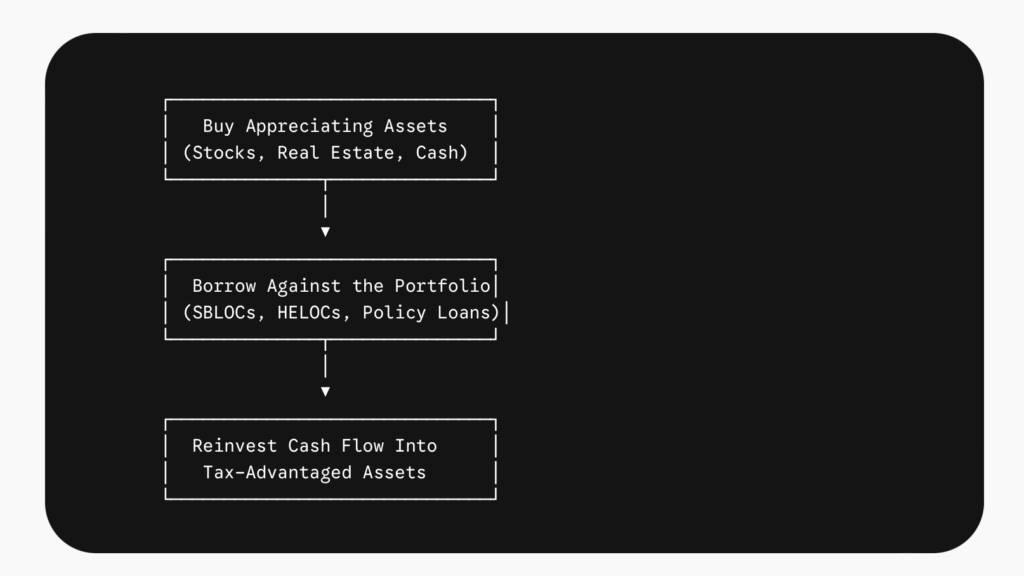
Beyond basic credit fixes, true generational wealth relies on asset-backed leverage—borrowing against existing assets at fractional interest rates (1% to 2%) rather than relying on 20% APR credit cards.
1. Portfolio Lines of Credit (SBLOCs)
Rather than liquidating stock holdings—which triggers capital gains taxes—high-net-worth investors borrow up to 50% against their brokerage portfolios at low rates. Your underlying stocks continue compounding while you deploy the borrowed capital into cash-flowing ventures.
2. The Tax-Offset Play
Instead of paying a massive tax bill in cash, consider directing capital toward cash-flowing real estate. Depreciation and cost-segregation strategies can yield dollar-for-dollar tax offsets, replacing a pure liability with a tangible, revenue-generating asset.
3. “Living Off the Drip”
Focus on acquiring assets that yield predictable cash flow. Reinvest active income into income-producing vehicles first, then cover lifestyle expenses using the ongoing yield rather than depleting the principal.
The Takeaway
Whether you’re starting with $500 or managing a seven-figure portfolio, the structural rules remain consistent: Automate your credit strategy, leverage low-cost capital, and convert liabilities into compounding assets.
You must be logged in to post a comment.